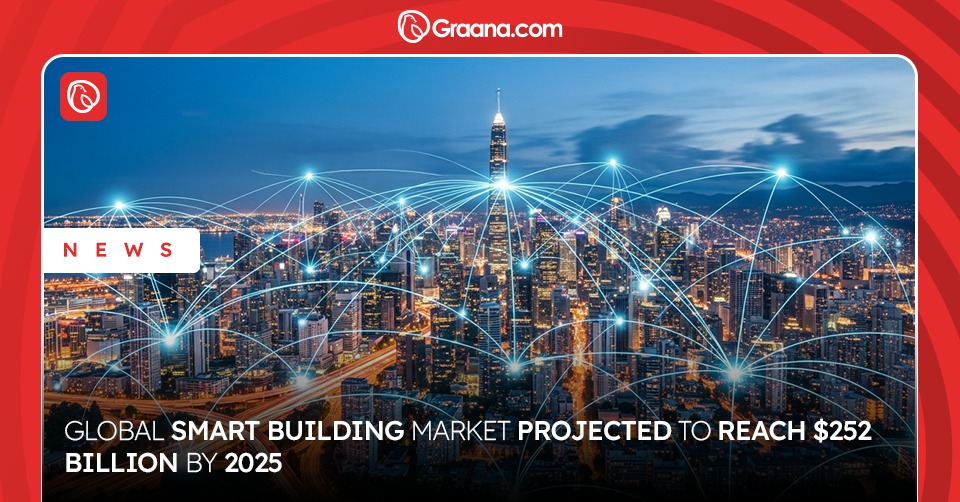
Source: Graana.com
The global smart building market is projected to grow by at least 21.8% in 2025, reaching a valuation between $117 billion and $252 billion, according to Xylem Vue. This growth is fueled by the adoption of advanced technologies such as artificial intelligence (AI), the Internet of Things (IoT), and sophisticated data analytics platforms that enhance operational efficiency and sustainability.
Smart buildings, integrated with ICT (Information and Communication Technology) systems, are reshaping how energy and resources are managed in urban areas. The shift toward urban sustainability is also being bolstered by district heating and cooling (DHC) networks, which are streamlining thermal energy distribution and enabling more effective use of renewable energy sources.
The integration of digital platforms is proving vital in managing and optimizing building systems in real-time—from lighting and air conditioning to parking and energy use. Emerging tools like digital twins and energy management systems are being widely adopted to predict maintenance needs and improve resource efficiency.
Fortune Business Insights projects a compound annual growth rate (CAGR) between 21.8% and 29.7% across key segments like energy management and security. Commercial buildings are expected to maintain a leading market share of 53% in 2025, driven by efficiency gains and reduced operational costs.
Beatriz Bolonio from Xylem Vue emphasized that leveraging data through integrated platforms is revolutionizing building management and enabling the development of greener, smarter cities.
In parallel, DHC networks are emerging as a critical component of smart cities, offering low-emission solutions through the integration of renewable sources and waste energy recovery. These systems allow for real-time adaptation to building-specific thermal needs while minimizing operational footprints and maintenance expenses.
With continuous monitoring and optimization, DHC and smart building platforms are helping urban areas transition to circular, energy-efficient models—placing them at the heart of future sustainable city planning.
Islamabad: The chairman of the Capital Development Authority (CDA) and Chief Commissioner Islamabad, Muhammad Ali…
Peshawar: The Khyber Pakhtunkhwa government is exploring plans to construct a 31-kilometre outer ring road…
Islamabad: The National Highway Authority (NHA) has spent more than half of its development budget…
Karachi: A high-level meeting chaired by Sindh Minister for Local Government Syed Nasir Hussain Shah…
Riyadh: Saudi Real Estate Co. (Al Akaria) has signed a long-term lease agreement with Amsa…
Rawalpindi: The divisional administration has begun acquiring land for the Rs5 billion Thalian Interchange, a…
Welcome to Graana Blog - Pakistan’s Smartest Property Portal!
For more than a decade our intention has been to revolutionise the real estate industry in Pakistan. The same belief drove the vision of our real estate team, Graana where quality beats quantity.
We have introduced an extremely transparent and purposeful portal where we will help you buy, rent or sell your property. A place where you can sit back relax and let us market your projects and listings. We believe we have set new standards for the future of real estate in Pakistan by providing the smartest property portal.

