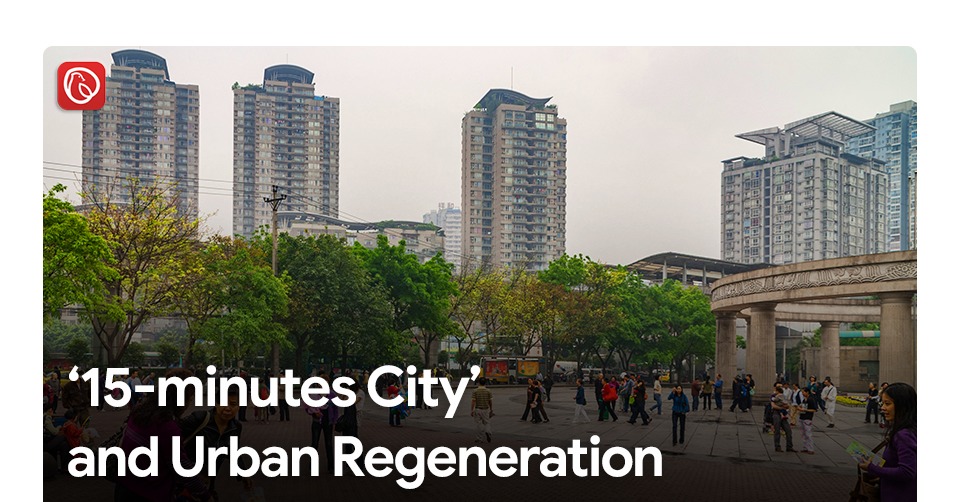
The concept of cities is continuously evolving and there are efforts underway to make cities more productive and responsive to the residents of a city. As the environment and the designs of our cities have a great impact on our lifestyle and the choices we make, cities can also play a decisive role in regulating our daily lives. However, it has been observed that the masterplans of the cities are expanding and the lives of the people are mostly spent travelling in the cities. This approach is being opposed in the policy circles as life in cities should not be only about travelling in vehicles.
Graana.com through this blog brings forth the concept of ‘15-minute’ cities an approach that has been lauded across the world owing to its environment-friendly nature. The phenomenon mostly pertains to the residential urban concept which is about negating the use of transport in the cities.
The concept of ‘15-minutes city’ can have a great impact on our social behaviours as it is about developing walkable neighbourhoods, defying approaches that promote long distances, and promoting regular walks and bicycles for achieving the things of daily necessities. The concept was given by a French-Colombian scientist Carlos Moreno. The major aim behind the evolution of this approach is to promote a local way of life in which six major components of life are within the reach of 15-min walk or bicycling.
The concept revolves around major components of density, proximity, diversity and digitalization. These components define the lifestyle of people in order to make life in cities more convenient. All of the mentioned components make a chain which is necessary for making a ‘15-min city’ operational. It is pertinent to mention here that this phenomenon is gaining importance owing to the environment-friendly aspect and the increased socialisation of the residents which is not common in ordinary cities.
Below mentioned are the components/characteristics for making a ‘15-min city’ operational.
For a ‘15-min city’ it is necessary that the concentration of the people in an area should be dense as it minimises the constraints of time and space. If we take a look at the example of old cities, one thing can be said for sure that population density had played an important role and everything was easily available within walking distance. Markets were easily accessible and people could conveniently reach their workplace through bicycles or by foot. Furthermore, this makes it easier for a business to flourish and minimises the unnecessary use of transport in the cities. For increased socialisation in the 15-min cities population density is an important component.
Proximity is another factor that defines the major concept of the approach. As it is evident from the name that these cities are designed in such a manner that they take into consideration the proximity of essential services in the residential areas. For example schools, workplaces, and commercial services should be within the range of walking or cycling distance. This concept is also an anti-thesis to the concept of zoning in the cities which has made the availability of the essential services in the cities. The distant services increase the transaction costs and it also reduces the efficiency of residents who have to spend most of their time commuting.
Multi-Purpose buildings have a significant role to play in the concept of 15-minutes cities. These buildings remove the constraint of spaces in the cities as they can accommodate various services in a single building. The earlier mentioned concept of proximity can also relate to the multi-purpose buildings which can provide easy access to the residents and consolidate all the services in one place. It is pertinent to mention here that these concepts can be replicated in ordinary urban approaches. Furthermore, the owners of the buildings can diversify their portfolios for monthly earnings.
One of the most important components of such cities is that there is no room for motor vehicles. The major motive of this approach is to negate the use of motor vehicles in the city and promote the environment-friendly commute in the cities. Therefore, such cities include tracks rather than roads in order to provide residents with a walking and cycling track for accomplishing their daily tasks. This promotes environmentally friendly practices in the city.
Karachi: A high-level meeting chaired by Sindh Minister for Local Government Syed Nasir Hussain Shah…
Riyadh: Saudi Real Estate Co. (Al Akaria) has signed a long-term lease agreement with Amsa…
Rawalpindi: The divisional administration has begun acquiring land for the Rs5 billion Thalian Interchange, a…
Islamabad: The Federal Board of Revenue (FBR) is preparing to seek approval from the International…
Riyadh: As Saudi Arabia’s Vision 2030 enters its third phase for the period 2026–2030, the…
Islamabad: The Capital Development Authority (CDA) has earmarked PKR 200 million to settle outstanding land…
Welcome to Graana Blog - Pakistan’s Smartest Property Portal!
For more than a decade our intention has been to revolutionise the real estate industry in Pakistan. The same belief drove the vision of our real estate team, Graana where quality beats quantity.
We have introduced an extremely transparent and purposeful portal where we will help you buy, rent or sell your property. A place where you can sit back relax and let us market your projects and listings. We believe we have set new standards for the future of real estate in Pakistan by providing the smartest property portal.

