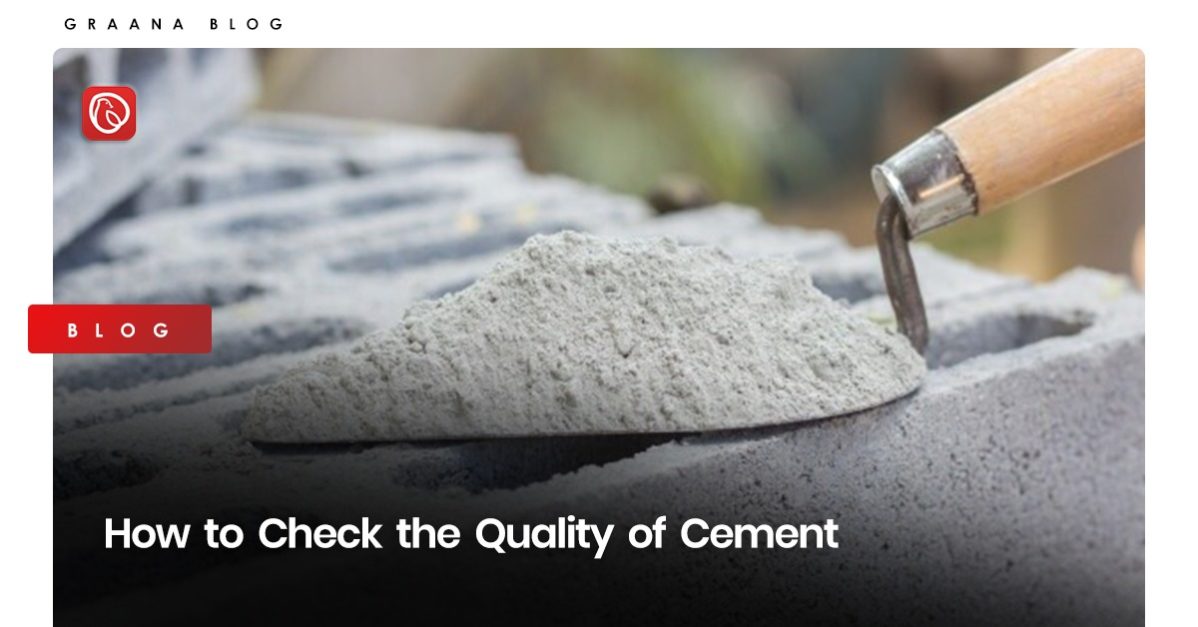
Good quality cement is crucial in construction. Graana.com brings you a guide on how to check the quality of cement.
Among all materials and substances, cement is used the most in all construction projects. It performs the function of a binder and is responsible for holding gravel and sand together. It is crucial to know how to check the quality of cement.
It plays a key role in the construction and, hence, should be durable enough to withstand extreme temperatures, water and human activities.
Although it is not easy to evaluate all the qualities of cement on-site, there are certain preliminary field tests that can provide a basic indication of its quality.
Graana.com has compiled a list of some simple tests that you can carry out in order to determine the quality of the cement being used.
Here is a list of things you can do to check the quality of cement.
In general, cement should be utilised no more than ninety days after the date it was manufactured. This is because cement loses strength over time. Most of the cement companies in Pakistan have clearly written the date of packaging on their products.
The cement should have a colour that is either light or grey, with a hint of green, and it should be consistent throughout its packaging. However, this also depends on the type of cement used in the construction.
The colour exhibits characteristics that point to an excessive amount of either clay or lime, as well as a high degree of burning.
The lump test determines whether or not a material has absorbed moisture by checking if it has formed lumps. The presence of these is evidence that the cement has begun to set.
Therefore, you should take care not to purchase cement bags that include lumps that are both little and hard. The cement must instead have a smooth texture, which you can check by running it between your fingertips.
When sand has been mixed in with cement, it has a grainy texture.
In order to determine whether cement has a significant amount of pulverised silt and clay as an adulterant, you should sniff a little amount of the material and check if it has an earthy odour.
Cement Temperature Test
If you put your hand into a bag of cement, you should feel a degree of coolness rather than warmth. This suggests that the cement in the bag has not yet undergone the hydration process.
When a tiny amount of cement is mixed with water, the cement particles should float on the water’s surface for some time after the process has been completed.
Take one hundred grams of cement and a small amount of water. Mix the two to produce a thick paste. Mould it into the shape of a cake with pointed corners, place it on a glass plate, and then gently submerge it in the water.
Take care not to deform its shape in any way when you do this. After twenty-four hours, the cake should be able to keep its original form while also being firm and having some degree of stability.
Make cement blocks of the following dimensions: 200 millimetres in length, 25 millimetres in width, and 25 millimetres in height. Allow them to sit for seven days to cure. After that, position it so that it is resting on a support that has a span of 150 mm.
After that, a weight of about 34 kilogrammes should be loaded onto the cement sample. If it is quality cement, it should be able to support the weight without being deformed in any way.
Before putting cement to use, it is of the utmost importance to examine and confirm the product’s quality. On the building site, this may be accomplished with the use of the aforementioned cement tests.
You won’t be able to examine all of the cement’s engineering qualities on-site. Still, you should be able to run some basic physical field tests readily, the results of which should give you a good indication of the cement’s quality fairly quickly.
This was all about how you can check the quality of cement.
For more informational content, visit the Graana blog.
Islamabad: The chairman of the Capital Development Authority (CDA) and Chief Commissioner Islamabad, Muhammad Ali…
Peshawar: The Khyber Pakhtunkhwa government is exploring plans to construct a 31-kilometre outer ring road…
Islamabad: The National Highway Authority (NHA) has spent more than half of its development budget…
Karachi: A high-level meeting chaired by Sindh Minister for Local Government Syed Nasir Hussain Shah…
Riyadh: Saudi Real Estate Co. (Al Akaria) has signed a long-term lease agreement with Amsa…
Rawalpindi: The divisional administration has begun acquiring land for the Rs5 billion Thalian Interchange, a…
Welcome to Graana Blog - Pakistan’s Smartest Property Portal!
For more than a decade our intention has been to revolutionise the real estate industry in Pakistan. The same belief drove the vision of our real estate team, Graana where quality beats quantity.
We have introduced an extremely transparent and purposeful portal where we will help you buy, rent or sell your property. A place where you can sit back relax and let us market your projects and listings. We believe we have set new standards for the future of real estate in Pakistan by providing the smartest property portal.



